I’ve been doing a lot of writing lately and, as always, I find that after a long, intense spell of being immersed in writing fiction I need a complete break.
This break tends to be baking (yum! everyone benefits!), gardening (nice looking sunflowers growing happily!) and, after a few days of being brought from mind to body, reading.
Photograph of five books: Trading Time by Owen Martin, Let me tell you what I mean by Joan Didion, The Unlimited Dream Company JG Ballard, The End Of The World is a Cul De Sac by Louise Kennedy, Yours ‘Til Hell Freezes: Kevin Barry by Síofra O’Donovan.
I’m enjoying the other world immersion and the mix of genres I’ve selected. I am enjoying, to quote Roland Barthes
the change in the level of perception…both reading and writing are redefined together.
I am also looking forward to my next few Writers Chat interviews which are based on reading some of the books in the photograph above.
Whatever you are reading – be it book, newspaper, online, hardcopy, paperback, on screen – after immersing yourself in another world, relish the change in your perception of your world.
Lisa, Welcome back to my Writers Chat Series. We’re here to chat about your second novel Bright Burning Things (Bloomsbury: London, 2021) which Lisa McInerney has so accurately described as ‘a meticulous portrait of a life unravelling’.
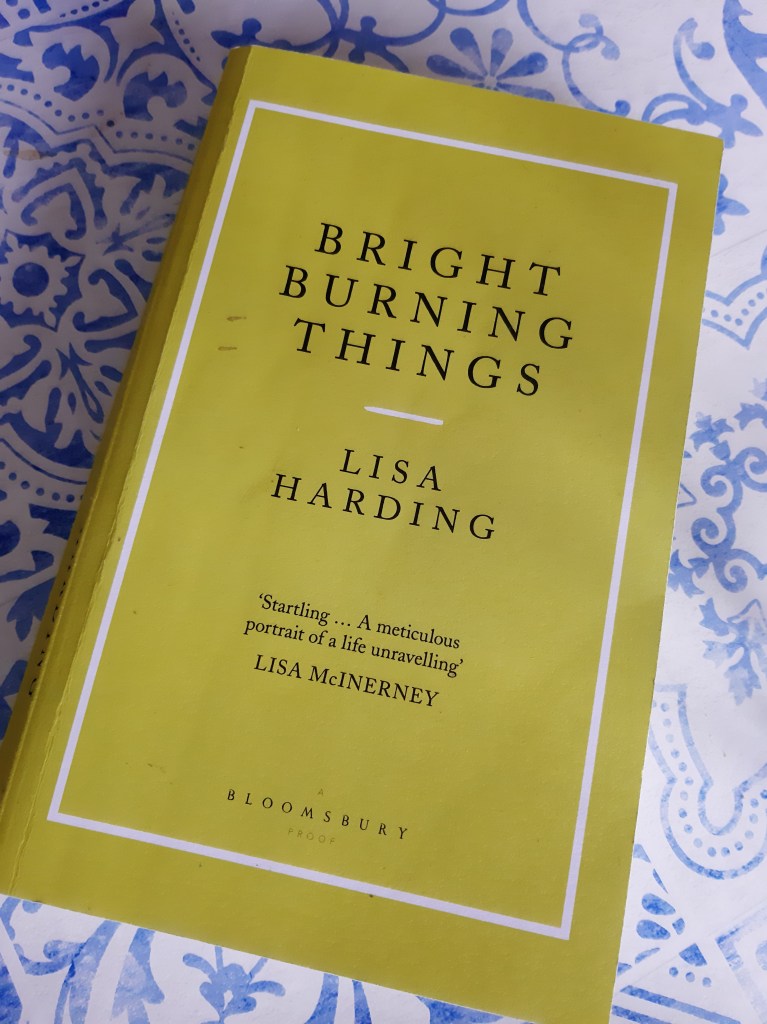
Bright Burning Things – Cover Image
SG: Let’s start with Sonya’s narrative voice. It’s through her – often unreliable – lens that we encounter those around her: her son Tommy, her father, Lara, David – as well as the unfolding of her story. Tell us about developing a narrative voice so strong that it literally pulls the reader along, turning page-after-page.
LH: Thank you for saying that. Honestly, I didn’t know whether she would just turn people off (although I fell in love with her writing her). She’s so unfiltered and raw and angry and damaged and full of contradictory feelings…and intoxicated so much of the time that I felt like I was as out of control as she was when I was writing it. I went back to my younger, wilder, drinking days and also my acting days. I let her do all the talking. It’s a bit like possession when a character like that grabs hold of you. Method-writing in a way. I improvise when I write and like to let myself be surprised by my characters. Sonya shocked me as much as I imagine a character ever could. And that has to be a good thing, right?
SG: I think it really is a good thing – it meant the story came as much from delving into her character as mining from your creative self and the authenticity shows in the wonderful flow. The title Bright Burning Things is perfect for what it represents and how it encompasses both Sonya and Tommy – living itself, even. Did this come early or late in the process?
LH: The title changed at the very last minute. I love it now. Originally it was called OVERSPILL and stayed that way for a long time in the process, as it really is a study in intergenerational trauma and addiction. I prefer Bright Burning Things though as it’s more suggestive and allegorical in a way. The imagery of fire burns bright from the first chapter to the last – all unconscious on my part.
SG: I love when that happens – the wonderful symbols that can emerge from the process and when they work so well as they do here.
You deftly capture the strains that can exist between parents and children – in both Sonya and Tommy’s relationship but also Sonya and her dad. The strain, I felt, was also about identity – drinker, actress, mother, daughter, lover – as much as expressing emotion, as she says when her father praises her “Emotion has finally caught up with him, taken residence inside him – I wonder if this is a sign of him getting old.” Can you talk a little bit about that?
LH: Sonya’s relationship with her father and with her own self are at a moment of high tension when we meet them. As you so rightly observe, Sonya is in the grip of an identity crisis. Who is she really? She doesn’t feel a sense of belonging with her father and stepmother, she has lost her former career and she has been thrust into the role of mother with no memory of her own. I wanted to be with a complex character for whom the classic tale of recovery just won’t fit. I think Sonya faces up to all these parts of herself during the course of the novel, including unresolved grief from her childhood. She is finding some way towards managing her extreme emotions herself. Interesting how little emotion her father shows and how much she acts out of this. A cry for attention, perhaps?
SG: Much of Sonya’s troubles stem from her addiction to alcohol which exacerbates the intensity of her sensory experience in the world – including blacking out, neglecting her son and dog, but also caring too much – she worries about the suffering of animals who died to put food on our plate, and at during rehab her “night-times [are] filled with the ghosts of the orphaned children who once lived within these walls, still trapped.” Can you talk about how the world for Sonya, is “too much” but also how she cares “too much”?
LH: Yes, this heightened sensory experience is almost hallucinogenic at times for her. I think most of us know the ‘horrors’ of a bad hangover. She is either permanently intoxicated or hungover when we meet her. Being in the grip of addiction has a surreal, hyper saturated quality to it, both for the person suffering the addiction and for those around them. She has manic states that come about because she doesn’t eat properly, and her blood sugar levels are all over the place. Alcohol, obviously, plays a huge part in this. Everything is extreme with Sonya and when her acting career is removed from her life, she has nowhere to channel these impulses. She feels everything too intensely, including animal suffering, which is something her mind attaches to.
SG: That’s interesting the way you phrase that – as something her mind attaches to, part of what’s happening to her mind and body as opposed to a rational, conscious or ethical choice.
Sonya is an actress and in times of stress, she remembers roles she played – dancing in “an avant-garde production of Pride and Prejudice…wearing a corset, a crinoline-style dress, shot silk, pale blue, and suspenders” whereas now – after rehab – her “new character is called ‘Ms Sanity’ and Sanity has to hide her truth at all costs, Sanity has to smile and suppress, Sanity has to present a neatly packaged front to the world.” It struck me that her experience of the world revolves around controlling the experience she gives her ‘audience’, a skill which helps her assert herself in the face of subtle coercive control from the men in her life. Can you speak about this theme in the novel?
LH: That’s a really interesting observation, but not what I had intended! I had wanted her moment of reckoning with David, who is a coercive controlling man, to be devoid of artifice on her part, and a time where she accesses her authentic self. I feel by the end of the novel she has found her true voice somewhat and doesn’t feel the need to hide behind masks and roles. I think she even refers to this herself: ‘I find the voice I wish I could have found with my father…’ There is a clarity and a strength to her at that moment she asks David to leave. She is not in conflict with herself and knows who she is. You are right that she is very aware of the power she exerts as an actress, but in rehab she accesses some part of her that is real, for the very first time. This is an important step for her in becoming the strong woman and mother she is meant to be.
SG: I think we are speaking here about the same thing – she has found her authentic self but she knows how to use her skills for her own advantage now. I loved the imagery associated with Sonya’s mother who it seems to me, was not unlike Sonya – the Catherine wheel, the joy of life itself – the opposite to her father’s way of living – hiding truths, not speaking of darkness – and I wondered if (and from the last line of the novel “Silence falls like a velvet curtain. Swish”) we will meet Sonya again.
LH: I feel like we’ve had enough of Sonya (or I have) for now. I love books that end on a note of ambiguity, of promise, providing a talking point for the reader. Will she manage her impulses, will she be a safe mother for Tommy, will she be safe for herself? The final line was harkening back to her actress self. I think I wanted to suggest that all parts of her could come to bear and that she could be a mother and an actress. That it really was ok to be herself, that she didn’t need to reject any part of herself. In fact, I wanted the final note to be a celebration of all that she is: extreme, electric, talented, colourful, loving, maddening!
SG:And the final note is all that because Sonya is all that – right down to the choice of the last word “swish”.
Thank you so much for such generous and insightful answers, Lisa. We’ll finish off with some fun questions:
If you had to choose – Herbie or Marmie? Herbie was one of my all -time favourite characters to write. I am dog mad.
Do you write with or without music? Both, depending on my mood and how loud my neighbours are!
Coffee or tea? Tea all the way.
What are you reading now?In The Dark by Anamaria Crowe which is being published by Turas Press in May 2021. It is an extraordinarily beautiful and moving novel about life and love during Franco’s war-time Spain. The language is lyrical and mesmerising and I am enthralled.
Bright Burning Things Advance Copy (Love the lime green colour!)
Thank you to Bloomsbury and Cormac Kinsella for sending me an advance copy of the stunning Bright Burning Things (Bloomsbury, 2021)
Purchase Bright Burning Things here and keep up with Lisa on Twitter @LisaSHarding.
Grace, I’m delighted to welcome you to talk about your debut poetry collection The Limit of Light (Gallery Press Books: Meath, 2020). I really enjoyed hearing you read in The Gallery at 50 Celebratory Series (Episode 13 [time 10.59 – 15.30]) This collection holds a beautiful understated sensuality in its exploration of memory, body, desire, death, all without drama.
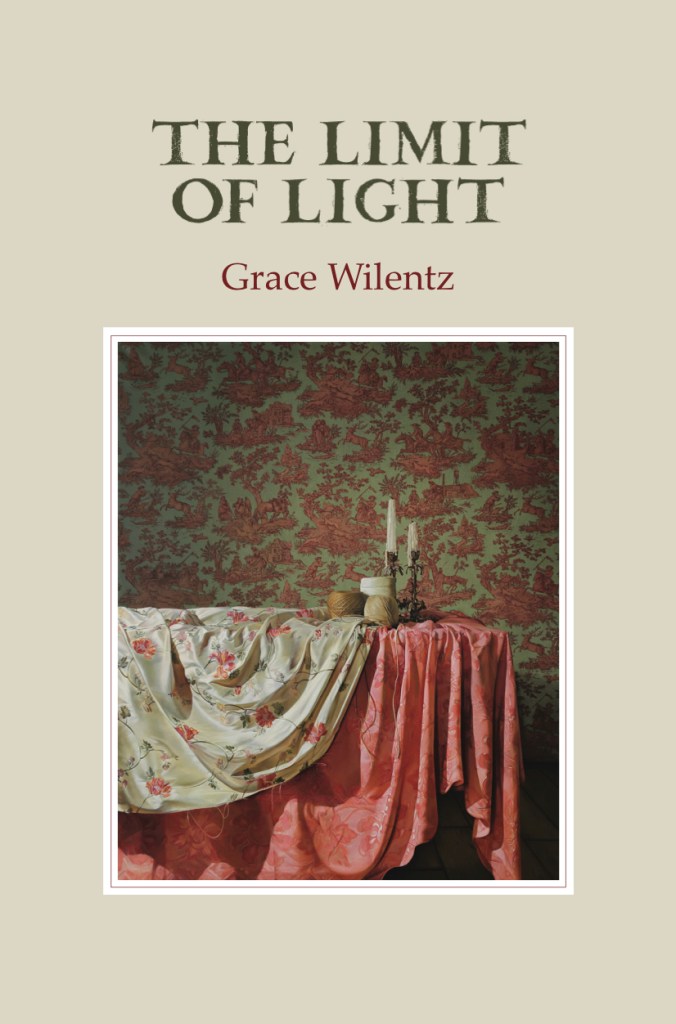
Cover image of The Limit of Light
SG: Let’s first talk about your journey as a poet, thus far. In that Episode you read the ‘Northern Lights’ by Nuala Ní Dhomhnaill, a poet who you say has had a huge influence on you making Ireland your home and who, like you, has lived in many countries and cultures. Could you talk about your reading habits and early influences?
GW: Firstly, let me say a huge thank you to you for inviting me to do this interview, and for giving The Limit of Light a platform to reach more people. Thank you, also, for your beautiful close reading of my work. Your questions are so reflective, and it means so much to have the work thoughtfully read by a fellow writer!
[SG: I’m so pleased the questions resonate with you, Grace.]
GW: My early influences were books of poetry for children. My parents read to me every night, and my favourites were illustrated books of poems like The Oxford Book of Children’s Verse and The Random House Book of Poetry for Children. Talking to the Sun edited by Kenneth Koch and Kate Farrell and illustrated with images from the Metropolitan Museum of Art is still a favourite. It was in listening to those poems before going to sleep that I began to know I loved language. It was also when I started learning poems by heart.
Since that time, the poets who have really shaped me include Elizabeth Bishop, Allen Ginsberg, Jorie Graham, Shane McCrae, Mary Oliver, Wisława Szymborska, Norman Dubie, Stanley Plumly, Ocean Vuong, James Merrill and Dorothy Molloy, just to name a few. I had the great fortune to study with Jorie and I still marvel at how I got to be so lucky.
Reading Nuala Ní Dhomhnaill at 18 led me to study the Irish language as an undergraduate. This was what drew me to Ireland, and changed the course of my life. Nuala Ní Dhomhnaill’s poems speak to me as much now as they did then. I love that her writing presents the world as a whole, with all of its sorrows and joys integrated. I respect the work she has done to protect the vitality and diversity of the Irish language. From Nuala I learned that one of the safest ways to ensure the longevity of something you love that is under threat, is to wrap it up with beauty, poetry, tenderness, vulnerability. That way, no one will be able to resist helping you care for it.
SG: I love the notion of wrapping what you love with beauty, poetry, tenderness and vulnerability. And what a varied list of influences! The Limit of Light is a beautiful production with the very arresting imagine ‘The Ties That Bind’ on the front cover. I found this fascinating – and immediately I linked it to the first few poems as I read, how every day objects, a turn of light, and patterns become signifiers for something else. Tell me about the link between the themes in this collection, the wonderful title and the cover image.
GW: I actually can’t take credit for the cover. Jennifer Truton’s beautiful painting was suggested by Peter, my editor. It was the right choice. For all that The Limit of Light is very forthright and honest in its subject matter, I hope that like ‘The Ties that Bind’ the book holds its mystery, and that the more time you give to it, the more depth will emerge. When I look at the painting, I feel as if it is calling me to use my imagination to assemble a narrative. I hope my book does that too, and that there is pleasure in finding the narrative threads that knit the poems together, and that everyone brings their own imagination and interpretation.
As for the title, I’m not sure if I can explain it so well, but The Limit of Light, is partly about reaching the depths of grief. It is about being in a place of extremity. And it’s also, perhaps, about being in that place where the light is disappearing and learning to see in the dark, finding a way forward when there is no path and no one to show you the way. Writing this collection, grief was a strong theme, but resilience equally so.
SG: Yes, I felt that as I read it grief was side-by-side with resilience. You read ‘Belly of the Whale’ so beautifully and evocatively.It strikes me that many of these poems explore the unspoken, the unnoticed and, to borrow a phrase from this poem, how time is “parcelled out”. ‘Belly of the Whale’ opens Part Three of the collection which follows on from the terribly moving sequence of poems about your mother and her cancer in which you offer the reader through a variety of wonderful forms a glimpse into your joint experience of health, care, and helplessness. It strikes me that perhaps this poem opens the door for another strong theme – that of grief. Can you comment on this?
GW: ‘Belly of the Whale’ is a poem about the summer after my mother passed away. She died in my last year of high school and suddenly I found myself alone, without family or the structure of school days. I just felt sort of suspended. I literally went days without speaking and remember not recognising my own voice when one day I ordered a sandwich at a local deli.
I did feel an incredible helplessness then, and all through her illness, like this thing was just barreling towards us and there was no telling how it would all end up. I wanted to write something authentic, that communicates honestly what those experiences were like, without putting a nice veneer on loss or fear, without any need to tie it all up in a bow. Just letting thing be as they are in the poem.
I recently collaborated with a brilliant filmmaker, Gabriela Concha Valcárcel, who made ‘Belly of the Whale’ into a short film. Our collaboration began in early 2020, just before Covid-19 reached Europe and South America, so almost from the start, we were constrained by it. But it forced us to be creative within strict limits. We used a lot of archival footage, reworking it to make something new. Gabriela was incredible to collaborate with, and she worked so intuitively to translate the poem from words to motion picture, that at times I wondered if she wasn’t a mind reader. I am so proud of what we made together and feel very excited to share it with audiences this year.
SG: The authenticity shines through, Grace, and my sympathies at the loss of your mother at such a tender age.The collaboration with Gabriela Concha Valcárcel sounds wonderful and I can’t wait to watch the ‘Belly of the Whale’ as a short film. Staying with your exploration of grief – which is also a contemplation on life – I was really struck by the symmetry between and structure of the poems ‘Hovenweep’, ‘The Limit of Light’ and ‘Last Look’. I found myself whispering the words aloud, and loved how a little further on, the incantation of ‘Alsace Shabbat’ really begs to be read aloud. Considering space, line breaks and stanza formation, do you think there is a link between sound and grief in these poems?
GW: I love that idea! I don’t know if I connected sound and grief in my own mind, but definitely when working with the ‘hot’ material of your own life, form can put some necessary structure and pressure to help shape it into art. I also take great pleasure in poems that are doing something sonically. It’s a powerful tool in terms of resonance, energy and creating an emotional response. Though I draft silently, I complete poems aloud.
SG: A great insight into your process, Grace, thank you – drafting silently, completing aloud. ‘Words on the Body’ is a beautiful exploration of memory, image, meaning and connection. I found the simplicity of story within this poem truly moving and made me consider how threads of time can suddenly become visible. Could you comment on your approach to writing poetry and the power of story?
GW: Yes, there’s definitely something there, as you say, ‘about the threads of time becoming visible’ or even inhabiting the same moment. Not all traditions conceive of time as linear; for some, it is cyclical. I think that poem, for all it seems kind of unassuming, is a hinge between parts of the book. To me, it’s looking backwards and forwards at experiences of love over time—and of being near to, and looking closely at someone you love. It’s about these two moments—being carefree on a beach with my mother in childhood, and then in adulthood, a partner presenting me with a bag of chips and integrating these two moments through these memories of text transferred onto skin. It is also in some ways about connecting the experience of the love within the family you’re born into, and the love you experience in the family you make for yourself. I am so glad the poem moved you, as when I take risks or try to do something more expansive, I’m always afraid it might not land.
SG: Social commentary is woven into your collection, too. ‘Covers: March 3, 1973 and December 19, 1942’ with, for me, a most beautiful end and a mantra in one: “What if everything I ever wanted/is what I have already received?”, ‘Becoming Esther’, ‘Handwriting’ and ‘The Deal’ where we witness your realisation of the existence of other, difference, transformation and privilege, and I include in this question the personal duo of ‘On a Gallery Bench’ and ‘Partridge Wrapping Paper’ which show the complexity and beauty of connection, again with a beautiful ending “YOU ARE THE LIGHT OF MY LIFE”. These have an echo with the final poem in the collection, the very current ‘A Year with Two Springs’. Do you think the personal and social are inextricably entwined in your work?
GW: That is a great question and something I am still coming to understand in my work. To me, the social and political are present, but they are explored through the lens of personal experience, so they don’t always declare themselves overtly. I think all of our lives brush up against the political issues of our time, and also the issues that are of all time—inequality, migration, difference, the challenges of human relationships, etc. and that a poem can encounter these subjects in many ways. I tend to favour, at least at this point in my career, subtler approaches.
SG: The Limit of Light warrants a read through as it is an almost magical experience in how you quietly build a picture of a live lived and living – with places, people and companionship threaded through it – but one can also dip in and out of sections. It seems that you are also searching for the commonality between ritual, tradition and travel – and turning a mirror to it for the reader. Was this a theme that emerged for you as you ordered the poems into sections, named the sections and prepared them for publication?
GW: I had not connected those themes in my own mind, but it’s very possible. I think tradition and change bring an interesting tension. Ritual is definitely there, both as a vehicle for meditative and emotional processes, but also in recognition of the parts of us that are open to believe and aren’t always rational. As for travel, it can be a way to understand the world better, and oneself better. Ultimately what I think holds them all together is the life at the centre of this collection. You’re so right, I am trying to communicate something lived as truthfully as possible. I didn’t always have the courage to do that and I hope I can stick with it.
SG: I love how my curiosity about your process and the meanings I took from your work often brought out new ways of seeing it for you, and in your generous answers, how I have begun to re-view the collection and will return to your poems with expanse and knowledge of some of what lies behind them. So, Grace, to end our chat, I’ve a few lighter questions:
Coffee or Tea? coffee (for now)
Silence or music when writing? silence
What are you reading now? The IChing, Gina Franco’s The Accidental, (re-reading) Jorie Graham’s Erosion and The Dream of the Unified Field, and Sally Rooney’s Mr Salary.
(Great diverse reading list – I haven’t read The IChing since I was a teenager. I must go back!) What are you writing now? I am completing a commission that is looking at new ways of exploring history through poetry. I am also working through my notes and slowly developing new poems for what might turn into my next manuscript, let’s see. I’m just having fun with it at the moment.
Well, I wish you all the very best with your commission (which sounds intriguing) and much fun with your new work. Thank you again, Grace, for your time and generosity with your answers. Readers, purchase The Limit of Light directly from Gallery Press and connect with Grace on her website.



 Shauna Gilligan Writer