I’m delighted that the eleventh post in my “Writers Chat” series is with Jane Clarke where we re-visit an old chat about her debut poetry collection The River and talk a little about her forthcoming second collection, When the Tree Falls.
SG: Jane, since the publication of The River in June 2015, you’ve been kept busy with one foot in the camp of creating new material and the other in continuing to give public readings, appearances and workshops.
You have also won various awards such as the Listowel Writers’ Week Poem of the Year Award (2016), Hennessy Literary Award for poetry (2016). And, of course The River was shortlisted for the Royal Society of Literature Ondaatje Literary Award. Many congratulations!
How have you found this process of managing the private creation of new writing and the public promotion of ‘old’ writing?
JC: Thanks very much, Shauna, for republishing my previous interview. It has indeed been a very busy time but well worth it to have so many opportunities to read my work, to meet readers and to perform with other poets and also musicians. The River has taken me to all kinds of interesting places and I’ve been honoured and delighted with the response to the poems. The private work of the poet entails getting new poems going and then working to get each one as good as it can possibly be. You definitely need plenty of quiet, reflective time for this. But when the poems are ready, I believe it’s really important to get them out into the world; readings, prizes, social media, youtube are all ways of doing that. I once heard Don Patterson say that poetry is a public art and I agree. Poetry, like music, needs the interaction of writer and reader/listener through live events.
I never expected such a warm response to The River. It’s a privilege to touch other people’s lives in this way. There’s nothing better than someone telling me they have The River beside their bed, or that the copy on the kitchen table is dog-eared or that they’ve given it to a friend who’s ill or that someone borrowed their copy and never gave it back or that their mother loves it. I’ve learned that when you publish your poems, you give them away and these intense little objects gain meaning and resonsance for others that has nothing to do with me personally.
SG: Yes, for a writer it is heart-warming to receive responses like that from readers. There’s a magic to how published work gains a life and meaning of its own, a beautiful exchange of a gift between the writer/writing, and the reader/reading.
Can you tell us a little about what you’re working on now and how your second collection is coming along?
JC: Yes, I’m working on my second full-length collection, When the Tree Falls. It’s due for publication with Bloodaxe Books in the autumn of 2019, which I have to say is both daunting and exciting. I feel very fortunate to have the support and imprimatur of my editor, Neil Astley and all in Bloodaxe Books. The experience of accompanying my very close friend, poet Shirley McClure, and my father in their final illnesses has deeply influenced this collection.
I know there’ll be poets reading this interview who miss Shirley very much. She was warm, generous and beautiful, a gifted creative writing tutor and a smashing poet. Her many fans will be glad to know that her publisher, Arlen House, plan to bring out a Collected Shirley McClure over the next year or so.
I’m also working with the Mary Evans Picture Library in London on a sequence of poems in response to a World War I family archive of letters and photographs. I’ve never worked on a project like this before and I’ve learnt a lot about the First World War and also the wealth of other artistic responses to the war, including poetry. It’s quite a challenge to find fresh ways of writing about the experience. I’m conscious of the dangers of over-statement and worn-out imagery and have sought an allusive, “tell it slant” approach.
One other piece of work is co-editing, with Nessa O’Mahony, the special Irish issue of the much-loved UK poetry magazine, The North. It‘ll be published late this year with a big launch in Poetry Ireland. We hope it will showcase lots of wonderful work by Irish poets and reflect the incredibly vibrant poetry scene here. I’d like to acknowledge Peter and Ann Sansom’s generosity and vision in giving us this opportunity to present and promote Irish poetry. It is particularly valuable and resonant in the midst of the anxiety and sadness about Brexit.
SG: Jane, it sounds like you are in a powerful creative space, right now.
I love the title of your next collection, When the Tree Falls. And what a wonderful tribute to your dear friend Shirley, and your father, that the privilege, heartbreak and grief around their passing has been so carefully and lovingly tended to in poetry.
It is heartening to hear that Arlen House will bring out Collected Shirley McClure.
The world war poems sound fascinating, I’m already intrigued by the process. Thank you for sharing that.
I really look forward to The North, and congratulations on what sounds like a brilliant project.
Now I’d love to hear about any readings or events you have coming up over the next while.
JC: I’m looking forward to going to the Lake District to run a “Writing & Dry-Stone Walling” workshop with James Rebanks, the author of The Shepherd’s Life. Both our books were shortilisted for the Ondaatje Award and we’ve kept in touch since. The workshop is part of the Rural Writer’s Institute and I’m looking forward to meeting lots of other rural/nature writers there. http://www.kathrynaalto.com/writing/rural-writing-institute/
The poet, Eileen Casey, has edited a new anthology of poems responding to the poetry of Patrick Kavanagh. As he’s one of my favourite poets, I’m honoured to have a poem included, responding to a gorgeous short poem of his, “Consider the Grass Growing.” The anthology, The Lea-Green Down, will be launched in the Irish Writers Centre on the 18th July at 6.30pm. I also have a new poem in the Arlen House/Hodges Figgis Anthology, Reading the Future. I’ll be reading at one of the series of launches planned over the coming months.
At the end of August I’ll be going on the road with the wonderful traditional and classical musicians, Eamon Sweeney and Cormac Breathnach, for a series of concerts as part of Heritage Week, 2018. I’m giving a talk about the First World War poets and reading from my own sequence in Richmond Barracks as part of the Festival of History in October. And on the horizon, there’s another trip to the US for a number of readings.
SG: It really sounds like you have a wonderful few months ahead of you, Jane. I wish you the very best of luck and I’m sure both you and your audiences will enjoy the events very much.
Thanks, once again, for stopping by and I’d love to have back to talk more deeply about your second collection.
Below is our Q&A originally published in October 2015.
Q&A with Jane Clarke originally published in October 2015.
First of all congratulations, Jane Clarke, on the publication in June 2015, by Bloodaxe, of your debut collection The River. It is beautifully produced with a front cover image that somehow reflects the depth of the emotions and narratives within. I’m delighted to feature you on my blog and chat about The River.
SG: I’d like to learn more about the process of ‘producing’ The River. How did you select the 50 poems that made it to the final collection and how easily or difficult did the title come to you? And finally, did you have any input to the design?
JC: I began writing poetry ten years ago and about four years later I started to think about drawing together a collection. It took another four years before I had it ready to send out to publishers. Over that period I did an MPhil in Writing in the University of South Wales where I was given invaluable help with my growing collection, including the crucial advice not to rush it and to take more time. It was relatively easy to select the poems because I was adamant that only the very best of what I had written could go in. There were a few I wasn’t sure about which got moved in and out a number of times. The collection was accepted for publication in late July 2014 but I was still editing newer poems for it right up to the day I sent the final manuscript in March 2015. The hardest part of “making” the collection was the sequencing, which I changed many times. In ways it was like writing a poem; doing a draft, reading it, redrafting, putting it away for a while and then coming back to it and drafting again. In shaping the collection I was looking for a thread through the collection as a whole as well as variety and movement and also resonances between and among poems. My friends and colleagues, Shirley McClure, Geraldine Mitchell, Grace Wells and Yvonne O’Connor all helped me with this along the way. Meantime my workshop group was helping me with individual poems.
One of my first ideas for the title was Where the river deepens so the river was there from the start. Somewhere along the way I realized I wanted it to be The River, to reflect what I saw as the strongest poem in the collection and also to reflect the themes of change and loss and what nature offers us.
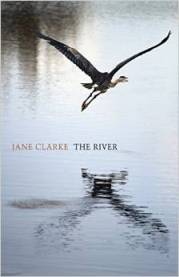
I had very little input into the design and I was more than happy to leave that to Neil Astley. When he wrote to confirm that he would be publishing my collection, he suggested the image of the heron, inspired by a line in one of my poems, “River at Dawn”.
………………………………………… A Heron flies up
from the callows, leads river and rowers
into the day, lean in, catch, pull back, release.
I love the cover and the lay-out and I have no doubt that the beauty of the production has brought quite a few readers to the book.
SG: As a fiction writer, I am always fascinated by and in awe at how poets often seamlessly feature place so strongly in their work. In this collection we move through fields, farmyards, rivers, lighthouses – some place-specific – and cities. Parallel to place, notions of ownership and belonging seep through as themes. Was there a conscious sense of themes corresponding to places in your life as you pieced the collection together in the order that it is in, or was this something that appeared organically?
JC: When I began writing I had no idea that place would feature so strongly in my work. But the poems kept coming out of the landscape and physical surroundings of various times in my life; growing up on a farm in Roscommon, my fifteen years studying and working in Dublin, living in Wicklow since then and other places that have mattered to me along the way. I can see now that the physical details of place both carry and express the emotions in my poems. The containment of place gives me a way of exploring relationships, ambivalent emotions and themes of belonging and identity. But I did not set out intentionally to do that. I have learned from drawing together my collection that if you let it, poetry will inevitably reflect and engage with your questions and concerns at the time you are writing. Some of these are questions you will repeatedly return to and others are of a particular time. I have been amazed to find how much of the process of writing poetry is an unconscious process. That is not to say that it doesn’t involve conscious dedication and craft but there is a well of unconscious associations influencing the work that sometimes seems magical. For example I only realised that “Among the Cows” was inspired by my grandmother’s life when I put it next to another poem about her in my collection.
SG: That’s fascinating, Jane, how the themes grew organically. It’s true that place in The River also extends to the place of our hearts – and memories. I’m thinking of the first poem in the collection: ‘Honey’ or ‘Rhode Island Reds’, poems which begin in one emotional, almost sentimental place, and end, shockingly and yet movingly, in an entirely different place. Or, in contrast, the brilliantly titled, heart wrenching ‘Every life’ which grounds us in the bodily place of possibility and impossibility.
JC: Thanks Shauna, I appreciate how you express your response to my poems. For me, part of the power of poetry is how it can allow the poet to write out of and into loss, either their own or the imagined loss of others. I have these lines from Macbeth on a yellow post-it above my desk, Give sorrow words; the grief that does not speak whispers the o’er-fraught heart and bids it break. To do this without sentimentality or self-pity, you need to be available to a depth of emotion as well as being able to stand at a distance from it. The restrictions of the poetic form can contain grief that feels uncontainable. Poems can’t give resolution or consolation but I have found that they can say what seems unsayable, evoke what has been unknown and that they can accompany, comfort and sometimes sustain others. Robert Frost says it for me: “A poem begins with a lump in the throat; a homesickness or a love sickness. It is a reaching-out toward expression; an effort to find fulfillment. A complete poem is one where an emotion has found its thought and the thought has found words.”
SG: That last line by Frost could apply to any form of creative writing, actually. Now while many of the poems are solid, and grounded in the specific, there are a few that have an undercurrent of the unconscious world of dreams, where danger is at the edges waiting to be acknowledged. The magical first stanza of ‘On the boat’:
“On the boat we were mostly virgins,/We talked about who we were going to be – /waitresses, seamstresses, nurses,/we didn’t talk about why we had to leave.”
Could you tell us a little bit more about this poem, for example the use of ‘mostly’ and the sense of journey and hope.
JC: I am always a little wary of talking about what a poem means for me because I don’t want to influence the reader’ response. But I know myself how interesting it is to hear a poet write about the background to a poem. “On the Boat” was inspired by Julia Otsuka’s novel, The Buddha in the Attic, about Japanese women migrating to the US in search of husbands. It set me thinking about all the Irish women who had migrated to the States in search of a better life. A visit to the Tenement Museum in New York’s Lower East Side also influenced the poem. The first line is the first line in Otsuka’s novel and what I liked about it was the question in “mostly” that let us imagine all the many reasons women left their home places apart from poverty or a sense of adventure, including rape, sexual abuse and pregnancy outside of marriage. I think it is what is not said as well as the strong rhythm, rhyme and repetition of the pantoum form that conveys a sense of mystery and at times menace as well as hope. There is also the intimation that regardless of getting the opportunity to start all over again, there are memories both wanted and unwanted that we carry with us.
SG: Of course, it’s a bit of a tricky question – almost like asking about inspiration! And now to my last question. Kent Haruf, one of my go-to writers who sadly passed away last year said in his last interview “The obvious thing is to read, read, read, read, read. Then write, write, write. There is no way around it.” As a poet, can you relate to this? When you are not writing, what are you reading? And what are you reading right now?
JC: I loved Kent Haruf’s Plainsong, Shauna. I hadn’t read his advice before but I totally agree with it. I find that reading both prose and poetry feeds my work. Reading sets off thoughts, memories and emotional responses. It can be a place, a time, a person that is evoked or sometimes just one word or a mood or tone sets something alight. When I haven’t been writing or when I want to get something started but can’t find a way in, it helps to take out a poetry anthology or a collection from a poet that interests me, read through it at random and just see what is sparked off. I always have a novel on the go; at the moment is Americanah by Chimamanda Ngozi Adichie whose writing is just getting better and better. I’m reading Caitriona O’Reilly’s latest, Geis and also Philip Larkin these days as well as dipping into Richard Mabey’s Weeds. I’m also reading Colm Tóbín’s very personal study of Elizabeth Bishop, who is one of my favourite poets. I remember when I first read her advice to a younger poet, “read a lot of poetry – all the time… anything at all almost that’s any good, from the past – until you find out what you really like, by yourself”. Only then should one proceed to “the great poets of our own century… and not just two or three poems of each… read ALL of somebody. Then read his or her life, and letters, and so on… Then see what happens.”
As regards the second part of Haruf’s advice, “write, write, write”, it is good to be reminded of it. The more I write, the more I need to write. There can be so much fear asscoiated with writing; fear of exposure, of failure, of coming across as ridiculous and yet we have to risk it, we have to put ourselves into words if we want to move closer to the writer we want to become. The advice I would add to that of Haruf and Bishop is to join a writing group and to set up a poetry reading group, on the lines of a book club.
SG: Thank you to Jane for such informative, and open answers. You can listen to a wonderful interview and reading with Jane on RTE Arena here and keep up with Jane’s readings and poetry on her website.



 Shauna Gilligan Writer